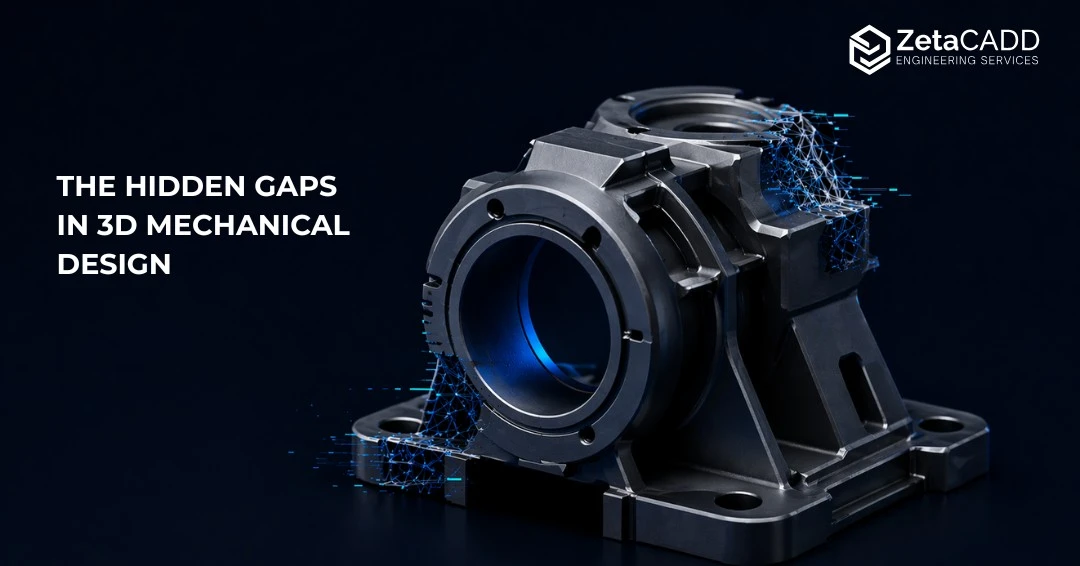
Unveiling the Hidden Gaps in 3D Engineering Design Services
The 3D mechanical engineering design services market has never been more competitive. Providers promise 30 to 50 percent faster prototyping cycles, deep savings through global outsourcing, and transformative results from AI-assisted CAD tools. Yet the gap between what is marketed and what happens on the shop floor remains significant.
Research into outsourcing outcomes consistently shows that a large proportion of mechanical design projects encounter delays, rework cycles, or manufacturing failures that trace back to gaps in execution, rather than gaps in intent.
These gaps are rarely discussed in vendor content, because vendors have no commercial incentive to raise them. This article is for mechanical engineers, product development managers, and procurement leads who are evaluating outsourcing options, reviewing their internal CAD workflows, or trying to understand why AI-generated geometry keeps failing at the tolerancing stage.
We examine three critical problem areas: outsourcing execution risks specific to mechanical design, technical friction in 3D CAD workflows, and the overstated capabilities of AI modeling tools for production-grade mechanical output.
Gap 1: Why Outsourcing 3D Mechanical Design Often Falls Short
Outsourcing mechanical CAD design and 3D modeling to offshore or freelance providers is a well-established practice. The cost arbitrage is real, and access to specialized software skills, such as SolidWorks, Siemens NX, PTC Creo, CATIA, without in-house hiring overhead is a genuine advantage.
What is consistently undersold, however, is how quickly those advantages erode when execution fundamentals are not locked down from the start.
It’s critical to understand that outsourcing 3D design involves navigating trade-offs around variable quality, communication breakdown, and intellectual property exposure that many companies underestimate before engaging external vendors.
These are not edge cases; they are routine failure patterns in mechanical design outsourcing.
Communication Breakdowns and Spec Ambiguity
The most common root cause of rework in outsourced mechanical design is not technical incompetence; it is the failure to communicate design intent precisely enough for a remote team to act on it correctly. An incomplete design brief leaves critical decisions to the discretion of the vendor. Those decisions may be reasonable in isolation but wrong for the specific functional requirements of the assembly.
File format incompatibility is a related and underestimated friction point. Mechanical CAD environments use a range of native and neutral formats: STEP, IGES, Parasolid, JT, and platform-native files like SolidWorks .sldprt or Creo .prt.
When a client uses SolidWorks and the vendor works in NX, a seemingly simple model exchange can introduce geometric degradation, lost feature history, broken parametric constraints, and suppressed configurations.
Poorly constrained parametric models create a cascade of problems: when dimensional relationships are not properly defined, a single feature change can break the entire model, forcing engineers to rebuild from scratch or spend hours tracing broken references.
Timezone and asynchronous review cycles compound this further. A single iteration that should take 48 hours can stretch to a week when client feedback and vendor response operate in different time zones without a structured communication cadence. For a mechanical OEM managing a product launch timeline, that kind of rework loop can add 20 percent or more to total project time.
Intellectual Property and Quality Control Risks
Mechanical design data is among the most commercially sensitive information a manufacturer holds. Detailed part geometries, assembly tolerances, proprietary fit-and-function logic, and material specifications represent years of engineering investment. Sharing these with external vendors across jurisdictions introduces meaningful IP risk, particularly when the legal enforceability of NDAs differs across countries and the vendor’s data handling practices have not been audited.
Quality consistency is the second variable that vendor marketing systematically skips. A freelance marketplace may offer access to engineers at multiple price points, but in-house teams carry institutional knowledge, platform familiarity, and direct accountability that a per-project freelancer cannot replicate. The spread between the best and worst output from a crowdsourced CAD engagement can be significant, and there is no guaranteed QA checkpoint before files are delivered.
Fixes:
- Define deliverables in technical terms: specify the CAD platform, file format, parametric constraint requirements, and GD&T standard before any work begins
- Enforce NDAs and data access agreements with restricted file sharing protocols before any geometry is transmitted
- Structure contracts around milestone-based deliverables with defined revision limits and acceptance criteria
- Require evidence of in-house QA review, not just self-certification, before accepting a deliverable
What Providers Promise vs. What Mechanical Engineering Teams Actually Encounter
| What Providers Promise | The Hidden Reality | What It Costs You |
|---|---|---|
| 30–50% faster prototyping | Spec ambiguity and revision loops add 20%+ to project time | Budget overruns, missed launch windows |
| Significant cost savings | IP exposure, format incompatibilities, and rework erode margins | Legal liability, lost proprietary geometry |
| Access to global CAD talent | Variable skill levels; no guarantee of GD&T or ASME Y14.5 competency | Rejected parts, costly ECOs |
| Scalable on-demand capacity | Freelancer quality is inconsistent; no in-house QA accountability | Inconsistent tolerances, fabrication failures |
| AI-accelerated 3D modeling | AI mesh output lacks parametric constraints for engineering parts | Non-manufacturable prototypes |
Gap 2: Technical Hurdles That Stall 3D Mechanical CAD Workflows
The productivity gains promised by 3D mechanical CAD tools, such as faster iteration, integrated FEA, DFM validation, digital prototyping, are real. They are also unevenly distributed.
Teams with well-established workflows, current hardware, and experienced engineers extract full value from these platforms. Teams in transition, or relying on outsourced resources operating on different platforms, encounter friction that promotional content rarely acknowledges.
Parametric Modeling Failures and Feature Management
A 3D parametric model is only as reliable as its constraint structure. In SolidWorks, Creo, or NX, every feature carries a dependency tree: if the references are incomplete or improperly sequenced, a later design change can propagate failures through the entire model. This is not a user error, it is an inherent property of history-based parametric CAD, and it demands a disciplined modeling methodology that many outsourcing vendors, particularly those working under price pressure, do not consistently apply.
The consequences show up late in the process, often at the point of FEA setup or during manufacturing preparation, when a geometry import fails or a feature suppression cascade reveals a model that was structurally unsound from early in its build. By that stage, rebuilding is faster than repairing, and the schedule impact is severe.
GD&T Deficiencies in Outsourced Mechanical Drawings
Geometric Dimensioning and Tolerancing (GD&T) is the symbolic language that bridges 3D CAD and the shop floor. While CAD models are theoretically perfect, real-world manufactured parts are not.
GD&T sets the allowable variation within which parts must fall to fit, function, and assemble correctly. Well-applied GD&T can improve quality, reduce costs, and accelerate time to market by synchronizing the intent of design engineers, machinists, and QA inspectors through a shared, unambiguous language.
The problem is that GD&T competency is not uniformly distributed among mechanical CAD practitioners. Outsourced vendors may produce geometrically accurate 3D models that carry incomplete, ambiguous, or outright incorrect GD&T annotations on the associated engineering drawings.
Misreading GD&T symbols or applying incomplete annotations leads to manufacturing errors even when the underlying model is geometrically sound. Legacy CAD systems and older workflows that do not fully support 3D model-based definition (MBD) create fragmented communication between design and manufacturing teams.
For high-precision mechanical assemblies like gearboxes, hydraulic manifolds, tooling fixtures, automotive powertrain components, a single incorrectly specified datum or an ambiguous position tolerance can translate directly into a batch of rejected parts. Add to it the Engineering Change Order (ECO) cycle that costs significantly more than the original outsourcing savings.
Moreover, tightening tolerances by a factor of two can raise manufacturing costs twofold or more, due to higher reject rates and tooling changes.
The implication is clear: tolerancing decisions made carelessly or outsourced to engineers without deep GD&T expertise can have a direct and disproportionate impact on unit economics.
Design for Manufacturability Gaps
A third category of workflow failure is the disconnect between what can be modeled in 3D CAD and what can actually be machined, cast, or fabricated at scale. Outsourced mechanical models sometimes arrive with features that are geometrically valid but manufacturable only at prohibitive cost: internal radii tighter than standard tooling, draft angles absent from cast or molded features, wall thicknesses incompatible with the intended process.
These are not obvious errors in the model; they require an engineer with manufacturing process knowledge to catch, and that knowledge is not always present on the vendor side.
Fixes:
- Require full parametric constraint documentation as a deliverable, not just the finished model
- Mandate ASME Y14.5 compliance for all GD&T on outsourced engineering drawings as a contractual requirement
- Standardize on STEP AP214 as the neutral format for all inter-platform geometry exchange to minimize translation loss
- Build a Design for Manufacturability (DFM) review gate before every tooling commitment
Top 5 Mechanical CAD Workflow Bottlenecks and Quick Wins
| # | Bottleneck | Quick Win |
|---|---|---|
| 1 | Poorly constrained parametric models breaking on edits | Enforce full constraint checks before release; never deliver under-defined features |
| 2 | STEP/IGES/Parasolid format mismatch at handoff | Agree on a single neutral format (STEP AP214) before project kickoff |
| 3 | Missing or incorrect GD&T on outsourced drawings | Require ASME Y14.5 compliance as a contractual deliverable, not an assumption |
| 4 | FEA/simulation failing on imported third-party geometry | Validate mesh quality and body continuity before simulation runs |
| 5 | Engineering Change Order (ECO) loops from late rework | Gate every design freeze with a DFM review before tooling is committed |
Gap 3: Imbalanced Narratives and AI Hype
The Problem with Vendor-Produced Content
The majority of published content about 3D mechanical design services is produced by the companies selling those services. This creates a structural bias: articles written by vendors focus on problems vendors are positioned to solve, not problems vendors create or leave unresolved.
Spec ambiguity, post-handoff ECO spirals, GD&T deficiencies, and format incompatibility failures are all well-documented in engineering practice, but they appear rarely in vendor content. Understanding what the industry is not telling you requires reading between the promotional lines.
Sticking to outdated or ineffective CAD workflows in engineering can significantly hinder innovation and damage customer satisfaction. Yet, those workflow limitations are rarely surfaced by vendors with an interest in presenting their services as friction-free solutions.
AI’s Precision Shortfalls in Mechanical Engineering Contexts
AI-assisted 3D modeling tools have attracted significant investment and marketing spend in recent years. Text-to-mesh generators, topology optimization AI, and generative design platforms can meaningfully accelerate the concept and ideation phase of mechanical product development.
However, a critical distinction is being systematically obscured in vendor marketing: AI-generated geometry is not parametric CAD output, and the difference matters enormously for engineering applications.
AI 3D generators work by statistically assembling plausible shapes from training data. They do not engineer; they approximate. The output is a polygon mesh that looks dimensionally correct but carries no parametric constraints, no feature history, no tolerancing intelligence, and no design intent that a downstream CAD or CAM system can act on reliably.
For visualization or early concept review, this is acceptable. For a functional mechanical component that will be tolerance-analysed, simulated under load, and machined to ASME Y14.5 standards, it is not.
This distinction is not academic. A mesh imported into SolidWorks for FEA preparation that carries geometry errors like non-manifold faces, inverted normals, and open shells will fail mesh generation and force a full rebuild in native CAD.
Teams that accept AI-generated output at face value because it looks correct in a viewport will discover the problem only when simulation or CAM preparation fails, at which point the time cost of rebuilding typically exceeds the time saved in ideation.
The hybrid workflow recommended by experienced practitioners is to use AI for rapid concept exploration and stick to native parametric CAD for engineering validation. While this sounds good, such an approach requires teams to understand the boundary between the two clearly.
Vendors selling AI-assisted 3D design services rarely define that boundary in their marketing.
Fixes:
- Use AI generative tools for concept ideation and form exploration only; never treat AI mesh output as a production CAD deliverable
- Validate any AI-generated geometry through native parametric CAD before FEA, tolerance analysis, or CAM preparation begins
- When evaluating vendors deploying AI in their workflows, ask specifically where AI output is validated, by whom, and against what standard
- Demand a clear handoff protocol: at what point does AI geometry transition to engineer-reviewed parametric CAD, and what is the acceptance check?
Bridging the Gaps: Your 3D Mechanical Design Playbook
The 3D mechanical engineering design services market delivers genuine value when it works correctly. Faster digital prototyping, integrated simulation, global access to specialist CAD skills, and reduced physical prototype iteration are real advantages that well-run engagements deliver consistently. The problem is not with 3D design services in principle — it is with the industry’s reluctance to give equal weight to the conditions under which those advantages are actually achieved.
Engineers and product development managers who understand these three gaps before they engage a vendor, invest in new tooling, or sign off on an AI-assisted design workflow are in a substantially stronger position. They write better contracts, ask sharper technical questions, and avoid the rework cycles that routinely absorb the savings that outsourcing was supposed to generate. Addressing these gaps systematically can reduce project risk by an estimated 25 to 30 percent, and more importantly, it shifts the team’s posture from reactive firefighting to proactive engineering governance.
Your 3D Mechanical Design Gap-Filler Roadmap:
- Vet providers on mechanical engineering fundamentals. Ask about their parametric modeling standards, GD&T competency (ASME Y14.5 or ISO 1101), file format protocols, and IP security architecture before signing any engagement. A provider who cannot answer these questions in technical terms is signalling something important.
- Build validation gates into your workflow. Mandate parametric constraint checks and DFM reviews before every design freeze. Require ASME Y14.5-compliant GD&T as a contractual deliverable on all engineering drawings. Standardize on STEP AP214 for all inter-platform geometry exchange.
- Demand transparency on AI tool limitations. Any vendor deploying AI in their mechanical design workflow must be able to specify where AI is used, what the validation protocol is, and how AI output is reviewed by a qualified mechanical engineer before delivery to you.
What is your biggest challenge in 3D mechanical design right now? Share it in the comments below. If this article helped clarify something you have been experiencing but could not name, share it with a colleague navigating a similar decision