


A Guide to Sheet Metal Design for Electronics Enclosures
Most articles about sheet metal enclosure design are written for manufacturers, companies that already have a finished design and need someone to bend and cut it. This one is written for the engineer still inside the CAD environment, making the decisions that determine whether that enclosure works, gets built on budget, and passes certification.
The costliest mistakes in electronics enclosure design don’t happen on the shop floor. They happen upstream, in requirements gathering, material selection, and how EMI shielding and thermal management are (or aren’t) baked into the CAD model before fabrication.
This guide covers the decisions that matter most.
Why Electronics Enclosures are Different from General Sheet Metal Work
Sheet metal is sheet metal until it has to protect a circuit board.
A structural bracket demands load, weight, and fit. An electronics enclosure adds an entire second layer on top: electromagnetic interference, thermal dissipation, ingress protection, regulatory compliance, and PCB mounting geometry, all of which must be designed in parallel, not as an afterthought.
Treating an electronics enclosure like a generic metal box is one of the most common and expensive mistakes in product development. A housing that looks right in CAD but ignores EMI continuity at its seams, or places vent cutouts without regard for IP rating, will fail in testing and require costly redesign.
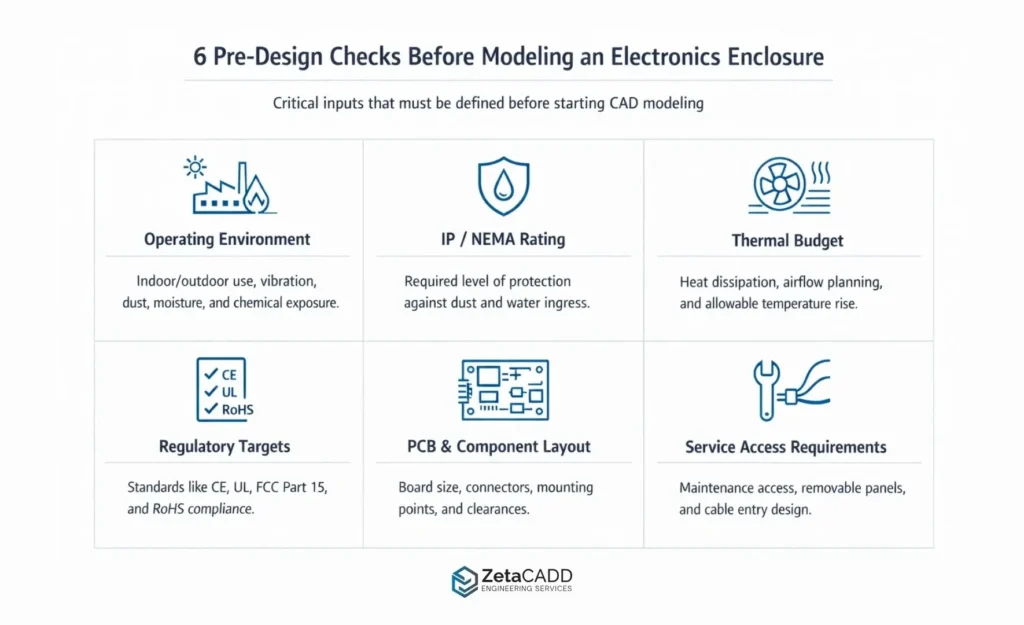
Before opening CAD, confirm six things: operating environment (indoor/outdoor, vibration, chemical exposure), IP/NEMA rating requirement, thermal budget (total power dissipation and max allowable temperature rise), regulatory targets (CE, UL, FCC Part 15, RoHS), PCB and component layout, and service access requirements.
Every one of these drives specific geometry decisions in the model. Finding out about a certification requirement after a design is complete is a project-killer.
Material Selection and What It Means for Your CAD Model
for Electronics Enclosures
| CRS Cold Rolled Steel Workhorse material | ALU Aluminum 5052 / 6061 | SS Stainless Steel 304 / 316 | GS Galvanized Steel General purpose | |
|---|---|---|---|---|
|
Weight
|
HeavyStandard density |
Very Light~⅓ of steel weight |
HeavySimilar to CRS |
HeavySimilar to CRS |
|
EMI Performance
|
ExcellentHigh magnetic shielding |
GoodBetter at high-freq (>30 MHz) |
Very GoodBroad-spectrum shielding |
ExcellentSimilar to CRS |
|
Corrosion Resistance
|
PoorNeeds coating/paint |
ExcellentNatural oxide layer |
ExcellentPassive chromium layer |
GoodZinc coating; degrades over time |
|
Formability
|
ExcellentEasy to bend & weld |
ExcellentHigh malleability |
ModerateHarder to form; K-factor 0.38–0.42 |
ModerateCoating can crack during forming |
|
Cost
|
LowMost cost-effective option |
MediumModerate material cost |
HighMost expensive; hardest to form |
Low–MediumGood cost vs. corrosion balance |
|
Best Application
|
Indoor panels, cost-sensitive industrial enclosures |
Lightweight, outdoor, heat-sensitive or portable enclosures |
Harsh environments — marine, chemical, food industry |
Outdoor general-purpose enclosures |
Material choice isn’t just a procurement decision. Every selection has direct implications for how the model needs to be built. Bend radii, wall thickness, K-factor, and finish requirements all cascade from it.
Cold-rolled steel (CRS) is the workhorse of enclosure design: strong, formable, weldable, and cost-effective. It provides excellent EMI shielding due to its electrical conductivity and magnetic permeability.
CAD consideration: CRS requires a secondary finish for corrosion protection, so powder coat thickness (typically 60–100 microns per surface) must be factored into tolerances on any mating feature. A powder coat on a tight-fit slot is enough to prevent assembly.
Aluminum (5052 or 6061) is the choice when weight matters, typically for portable equipment, consumer electronics, and airborne systems. It’s lighter, naturally corrosion resistant, and anodizes cleanly.
The CAD implication: aluminum’s lower stiffness often requires thicker walls than an equivalent steel design, which affects bend relief geometry. Its lower magnetic permeability makes it more effective at high-frequency EMI shielding (above 30 MHz) and less effective at low frequencies.
Also critical: anodize is electrically non-conductive. Any surface that requires metal-to-metal contact for EMI bonding must be called out as an anodize exclusion zone in your drawing package.
Stainless steel (304 or 316) is specified for corrosion resistance, hygiene, or extreme environment durability, which is typically useful for medical equipment, food processing, and marine applications.
However, it’s the most expensive and most difficult to form. Use a CAD material library entry that reflects its actual K-factor (0.38–0.42 vs. 0.44 for CRS) to ensure flat patterns unfold accurately, and apply more conservative bend radius minimums throughout.
EMI Shielding and Thermal Management in the CAD Model
These two disciplines are where most electronics enclosure designs run into trouble, and where a CAD-first approach pays the biggest dividends.
EMI shielding depends on electrical continuity across the entire enclosure surface. Every seam, access panel, ventilation hole, and connector cutout is a potential leakage point.
Three rules drive the CAD work:
The 20:1 aperture rule: limit aperture dimensions to less than 1/20th of the wavelength at the highest frequency of concern. At 1 GHz, that means every opening, vent slots, display windows, connector cutouts, must stay under 15mm in its longest dimension. Apply this consistently across the model.
Seam continuity: flanges at mating surfaces must be designed to accept conductive gaskets. Model the gasket groove geometry such as the depth and width dimensioned to achieve the manufacturer’s specified compression ratio (typically 20–30%).
Under-compression loses shielding effectiveness. Over-compression permanently deforms the gasket. Avoid powder coat or anodize on any mating surface where electrical continuity is required; mark these as bare metal zones in your finish callouts.
Grounding is a design feature, not a wiring task. Model a dedicated grounding stud location into the enclosure geometry, confirm metal-to-metal contact at all panel joints, and be explicit about where conductive surfaces must be maintained.
Thermal management follows airflow physics: cool air enters from below, heated air exits from the top. In the CAD model, position intake vents to align with or near high-heat components, and exhaust ports above them.
Louvered vents balance open area for airflow against ingress protection. For instance, a louver array for IP2X must keep openings under 12.5mm; IP4X requires under 1mm.
Fan mounting cutouts should be modeled from the manufacturer’s bolt circle dimensions, not the fan body diameter, and fan guard stack height needs to be confirmed against panel clearance.
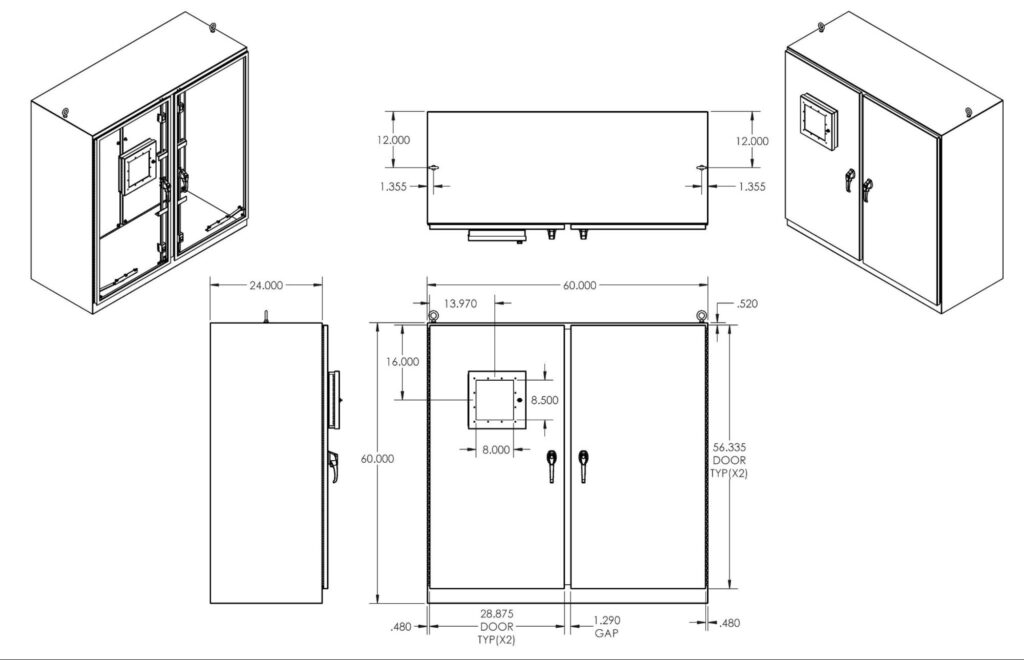
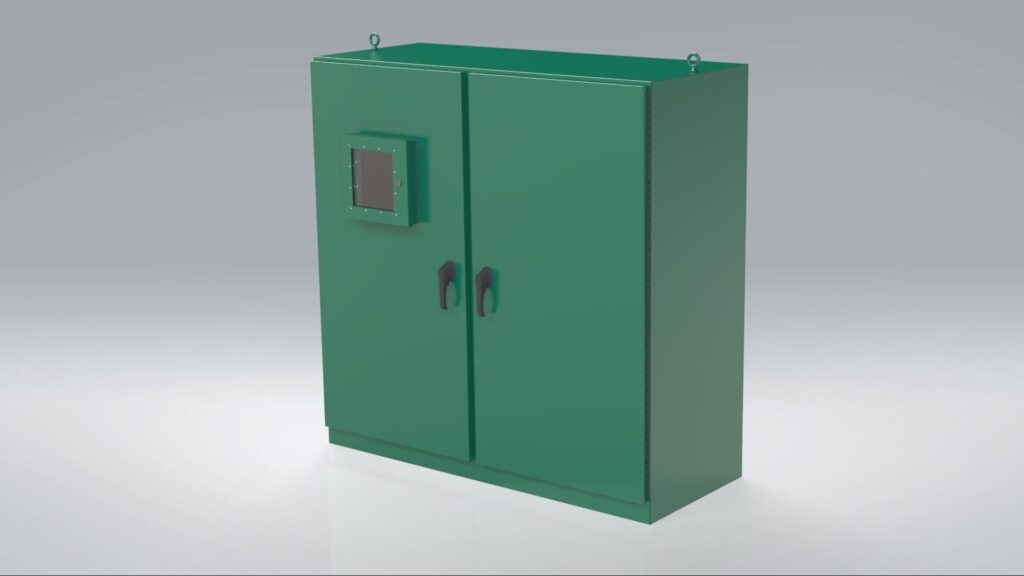
DFM Checklist: What to Verify in Your CAD Model Before Releasing to Fabrication
This is the practical step that separates designs that get built cleanly from designs that generate a back-and-forth of RFIs. Run through this before sending anything to the shop.
Bend geometry
All inside bend radii are ≥ material thickness (1.5x preferred). Bend reliefs are present at every interior corner. No holes are within 2.5x material thickness of a bend line. K-factor and bend deduction table matches the specified material.
Holes and cutouts
No hole diameter is smaller than material thickness. Hole-to-edge distance is ≥ 2x material thickness. Connector cutout geometries are derived from component CAD models, not estimated. All apertures comply with the 20:1 EMI rule at the highest frequency of concern.
Fasteners and hardware
PEM/self-clinching fastener insertion holes are dimensioned to manufacturer spec with correct edge distances. Standoff positions align with PCB mounting holes in the assembly model. Tool access clearances for hardware insertion are confirmed.
Assembly and fit
Lid-to-body gap is uniform and consistent with gasket compression requirements. Overlapping flange gaps are ≥ 0.5mm. Tolerance stack-up has been evaluated for all critical fit dimensions.
Finish and EMI
Powder coat/anodize exclusion zones are marked on all surfaces requiring conductive contact. Grounding point location and hardware are called out. All gasket groove geometries are modeled and not assumed.
General: Flat patterns have been unfolded and checked for errors. Surface finish callouts are complete, including bare metal zones.
Conclusion
Electronics enclosure design sits at the intersection of structural, thermal, electromagnetic, regulatory, and manufacturing engineering. Getting it right requires a design process that integrates all of these requirements from the first feature, not a series of late-stage fixes applied to a nearly finished model.
At ZetaCADD, our enclosure design work starts with requirements definition and ends only when the CAD model has been validated against a DFM checklist and confirmed ready for fabrication. That’s why our clients consistently hit quality targets on first-article inspection.
If you’re working on a sheet metal electronics enclosure and want a design partner who understands both the CAD and the manufacturing side, contact us to discuss your project.