How to Evaluate a CAD Conversion Service: 8 Questions to Ask Before You Sign
Not all CAD conversion services are equal. The gap between a good one and a bad one isn’t visible in a proposal. It shows up when you open the delivered files and find geometry that can’t be machined, dimensions that don’t match the source drawing, or a 3D model that looks correct but contains no parametric intelligence.
By that point, you’ve paid for the conversion, and your engineers are now spending time fixing someone else’s shortcuts.
The way to avoid this is simple: ask the right questions before you sign. Here are eight of them.
1. Is the Conversion Manual, Automated, or a Combination?
This is the most important question on the list, and the one most buyers never think to ask.
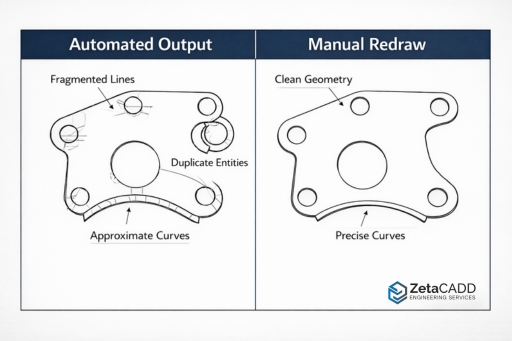
Automated tools can process files quickly and cheaply. For simple geometry, automated output can be acceptable. For anything more complex, it falls apart. Automated tools struggle with degraded source material, overlapping linework, and hand annotations. The output files typically contain fragmented geometry, duplicate lines, and approximated curves that look fine on screen but fail the moment they’re used in manufacturing.
A quality service will explain clearly when they use automation and when they default to manual redrawing. For engineering and manufacturing drawings, manual conversion is the only approach that reliably preserves accuracy and drawing intent.
2. What Is Your Quality Control Process?
Any service can claim accuracy. A QC process is what makes that claim verifiable.
Ask specifically: who checks the converted file, what do they check it against, and what tolerances are they working to? A credible answer describes a defined workflow, not a vague assurance that “our team reviews all work.”
For 2D conversion, QC should include a dimensional comparison against the source, a check for missing geometry, and a layer and annotation review.
For 3D CAD conversion, it should also confirm the model is fully constrained and that features are parametrically driven where required.
3. Do You Preserve Design Intent, or Just Geometry?
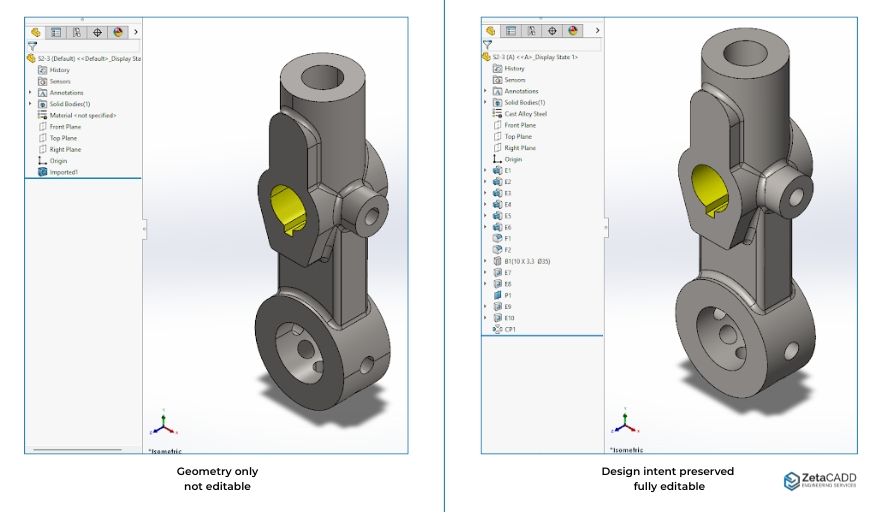
Geometry is what a drawing looks like. Design intent is what the engineer meant when they drew it: the relationships between features, the logic behind a hole pattern, the reason a radius is sized a specific way.
A service that only captures geometry delivers a static file that technically represents the original drawing but cannot be meaningfully edited. Every modification becomes a manual operation. For companies converting legacy drawing libraries for use in PLM systems or ongoing design work, this distinction is the difference between a usable asset and an expensive dead end.
A quality service will ask about your intended downstream use before quoting and confirm that their drafters build with sketch constraints, feature naming conventions, and model structure appropriate for your CAD platform.
4. What File Formats Can You Deliver, and Are They Native or Translated?
Native formats (e.g., .SLDPRT for SolidWorks, .CATPART for CATIA) preserve full parametric intelligence. Translated formats (STEP, IGES) preserve geometry but lose parametric structure. A service working in a different CAD platform than your team may deliver technically correct files that are the wrong format for your workflow entirely.
The service should be proficient in your target CAD platform, deliver native files in that format, and confirm that any translated output has been validated in the target software after translation.
5. How Do You Handle Poor Quality, Incomplete, or Contradictory Source Material?
Real-world legacy drawings are rarely clean. Scanned blueprints have faded lines and hand-written revisions. Old PDFs were printed and re-scanned, losing resolution each time. Drawings sometimes contain dimensions that don’t add up or views that contradict each other.
The wrong approach is to make assumptions silently and deliver a file that looks complete but encodes someone’s guess. The right approach is to flag ambiguities, ask for clarification, and document the decisions made where clarification isn’t available. Ask how the service communicates unclear source material and whether they maintain a revision log of resolution decisions.
6. What Are Your Data Security Protocols?
Engineering drawings are intellectual property. When you share files with a conversion service, you are extending your IP security perimeter to a third party.
Ask how files are transferred, how they are stored during the project, who has access, and whether they are deleted after delivery. A credible CAD conversion service uses encrypted file transfer, maintains access-controlled storage, and offers a mutual NDA without you having to request one. For defense or aerospace clients, confirm whether the service is ITAR-registered.
7. Can You Provide a Sample Conversion Before We Commit to Volume Work?
Any credible service should be willing to convert one or two representative drawings before you commit to a large project. Choose samples that reflect the actual complexity and condition of your archive, not your cleanest drawings.
A service that declines to provide a sample or insists on volume commitment before demonstrating quality is telling you something important about how they manage risk.
8. Who Will Actually Be Doing the Work?
Are the drafters in-house or subcontracted? What is their background? Is there a dedicated project lead for your account, or does work flow through a general queue? For offshore services, who is responsible for the English-language QA review?
You are not just buying file conversion. You are buying engineering judgment. A named project lead with relevant industry experience is meaningfully different from an anonymous queued workflow.
8 Questions to Ask
Conclusion
The difference between a conversion that produces accurate, production-ready CAD files and one that produces visually plausible geometry full of hidden problems is invisible in a quote. These eight questions give you the framework to find out before you commit.
At ZetaCADD, we answer all of them in our first project consultation because we believe clients should know exactly what they are getting before a single file changes hands.
Contact us to discuss your project or request a sample conversion from your own drawing set.