Using Skeleton Modeling to Manage 10,000+ Part Systems in SolidWorks
When a single design change causes hundreds of mates to fail simultaneously, the problem is not the engineer. It is the architecture. In large-scale SolidWorks projects, such as a 10,000-part packaging line or an aerospace engine assembly, the traditional Bottom-Up Design approach becomes a structural liability.
This article examines why Top-Down Design (TDD) powered by Skeleton Modeling is a technical necessity at scale, and how it resolves the performance and stability failures that Bottom-Up Design cannot.
The Cost of CAD Bloat in SolidWorks
Engineers spend approximately 15 to 20 percent of their time on non-value-added activities, including waiting for SolidWorks assemblies to load, rebuild, and save. For a project involving 10,000 parts, a single rebuild cycle can take several minutes. Twenty such cycles in a workday means over an hour of billable time lost, per engineer. Scale that across a team of fifty engineers and the annual cost of CAD Bloat reaches hundreds of thousands of dollars.
The bottleneck is rarely the hardware. It is the assembly architecture itself. Organizations aiming to reduce design inefficiencies and optimize engineering performance often address this at the architectural level rather than through hardware upgrades.
The Structural Flaw of Bottom-Up Design in SolidWorks
Most SolidWorks users are trained in Bottom-Up Design (BUD): model individual parts in isolation, then connect them in an assembly using SolidWorks Mates such as Coincident, Concentric, Parallel, or Distance. It works well for small assemblies. At scale, it fails for three specific reasons.
1. Cumulative Rebuild Overhead
Every Mate in SolidWorks is a mathematical constraint the assembly solver must resolve during each rebuild. In a large assembly, the solver processes thousands of these simultaneously. If Part A is mated to Part B, and Part B to Part C, a change to Part A forces a full recalculation of the entire dependency chain. SolidWorks rebuilds from the top of the FeatureManager tree downward, meaning a single upstream change can trigger a full-assembly rebuild even when most components are unaffected. The rebuild penalty compounds with every part added. Engineers dealing with such complexity often rely on advanced CAD modeling services for parametric assembly optimization to restructure assemblies efficiently.
2. Dangling References and the Red Rebuild Bar
Delete a hole in a baseplate that was used as a Coincident Mate reference for a bracket, and every downstream component that referenced it loses its anchor. SolidWorks marks these with the red rebuild indicator in the FeatureManager, and the What’s Wrong dialog surfaces a cascade of errors. In a large assembly, this can mean hundreds of broken mates appearing at once. Resolving them, whether through Fix, Suppress, or manual re-referencing, often takes far longer than the original design change. In Bottom-Up Design, this is not an edge case. It is an inevitability.
3. Circular External References
When multiple engineers work on sub-assemblies that reference each other’s geometry through In-Context editing, circular external references form. SolidWorks tries to update Part A based on Part B, which itself requires updated geometry from Part A. The result is out-of-context components that display with a dagger symbol in the FeatureManager, rebuild loops that never resolve, and assemblies that open in an unstable or error state. These issues are frequently addressed through reverse engineering and redesign strategies for legacy CAD systems.
The Solution: Top-Down Design and Skeleton Modeling
Top-Down Design in SolidWorks inverts the dependency structure. Rather than building from individual parts upward and linking them through Mates, the entire assembly is driven from a single centralized control part called the Skeleton Model. Every component listens to the Skeleton. Components do not reference each other. This approach aligns closely with early-stage system architecture planning and concept development services, where the overall structure is defined before detailing begins.
What Is a Skeleton Model in SolidWorks?
A Skeleton Model is a dedicated SolidWorks Part file (.sldprt) inserted at the top level of the assembly. It contains no solid bodies, only the geometric control data that defines the entire project. It typically includes:
- Reference Geometry: coordinate systems, planes, and axes that establish the assembly’s spatial framework
- Master Sketches defining overall footprints, key stroke lengths, and critical envelope dimensions
- 3D Sketch paths for routing, piping, or cable runs
- Space Claim volumes that reserve geometry for specific sub-systems
How It Works in SolidWorks
Each part or sub-assembly references the Skeleton through SolidWorks External References using Insert > Mirror Part or by deriving geometry through Convert Entities and Split Line operations tied to the Skeleton’s sketches and planes. Critically, these references flow one way: from the Skeleton outward to the components. Components never reference each other.
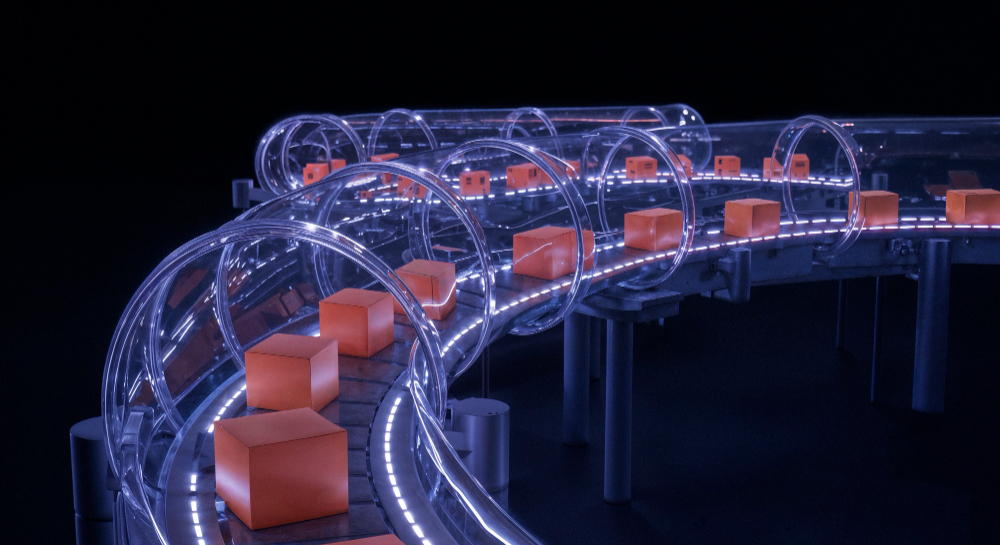
If the stroke length of a conveyor changes, the engineer modifies a single dimension in the Skeleton’s master sketch. Because every sub-assembly derives its critical geometry from that sketch, the entire 10,000-part system rebuilds predictably. No dangling references. No red rebuild bars. No tracing broken mates through five levels of sub-assembly. This methodology is particularly effective in industries involving complex sheet metal and large mechanical assemblies.
The Math of Stability: Coordinate System Alignment in SolidWorks
One of the most technically effective practices within SolidWorks TDD is positioning components using Coordinate System Mates rather than traditional face-to-face or edge-to-edge Mates. A standard Coincident Mate requires SolidWorks to continuously evaluate the distance and orientation between two geometric entities, both of which can change. In contrast, a Coordinate System Mate aligns the component’s origin and axes to a fixed Coordinate System defined in the Skeleton. It is a single, stable constraint.
This reduces the number of equations the SolidWorks assembly solver must evaluate per rebuild by orders of magnitude. At the scale of a 10,000-part assembly, that reduction translates directly into faster rebuild times, fewer solver conflicts, and a more stable FeatureManager tree. The difference between a Coordinate System Mate and a stack of three standard Mates is the difference between one constraint and three, multiplied across every component in the assembly.
Performance Management in Large SolidWorks Assemblies
Good modeling architecture solves the structural problem. But managing 10,000+ parts in SolidWorks also requires deliberate use of its performance tools. Three practices in particular make a measurable difference.
1. Simplified Configurations and Defeature
Loading every bolt thread, fillet, and internal feature of a complex sub-assembly while working on an unrelated bracket is unnecessary and slow. SolidWorks offers two tools for this. Simplified Configurations allow engineers to suppress non-critical features within a part or sub-assembly, reducing the geometry the solver must process.
The Defeature tool goes further, creating a separate output file that retains only the external surface geometry of a component. This lightweight representation can be referenced for clearance checking and spatial planning without loading any internal parametric data. Engineers see the outer envelope of a gearbox without loading its 800 internal components.
2. Large Assembly Mode and Lightweight Components
SolidWorks Large Assembly Mode automatically applies a set of performance settings when an assembly exceeds a defined component threshold. These include suppressing automatic updates, disabling verification on rebuild, and loading components as Lightweight by default. In Lightweight mode, only the graphical representation of a component is loaded into memory.
The full parametric model is only resolved when that component is activated for editing. On a 10,000-part assembly opened across a team of engineers, this approach directly reduces RAM consumption and load times. Engineers working in context should never be forced to load the full dataset of components they are not actively modifying.
3. The No External Reference Rule for Standard Hardware
Fasteners, bearings, bushings, and other standard catalog components should be treated as frozen assets in SolidWorks. They must never carry external references back to the Skeleton or to other parts in the assembly. If a standard M8 bolt carries an In-Context reference, every rebuild cycle attempts to resolve that reference, even when nothing about the bolt has changed.
Keeping standard hardware as fully independent, reference-free components prevents the rebuild ripple from propagating into parts that have no reason to change. In assemblies with high fastener counts, this rule alone produces a measurable reduction in overall rebuild time.
Design is Architecture
A 10,000-part SolidWorks assembly is not just a collection of geometry. It is a data structure that engineers will interrogate, revise, and hand off across months or years of product development. The architecture of that structure determines how fast the team can move, how safely changes can be made, and how reliable the model stays under continuous revision.
The principles described here, Top-Down Design, Skeleton Modeling, Coordinate System Mates, and disciplined performance management, are not advanced-user preferences. They are engineering fundamentals that become non-negotiable at scale. Any team building large assemblies in SolidWorks without them is working against the software rather than with it.
At ZetaCADD, these are not techniques applied selectively. Skeleton Modeling and Top-Down Design are the standard architecture for every large assembly engagement. The result for clients is not just a 3D model. It is a high-performance, revision-ready asset designed to support the full lifecycle of their product, built correctly from the start.