

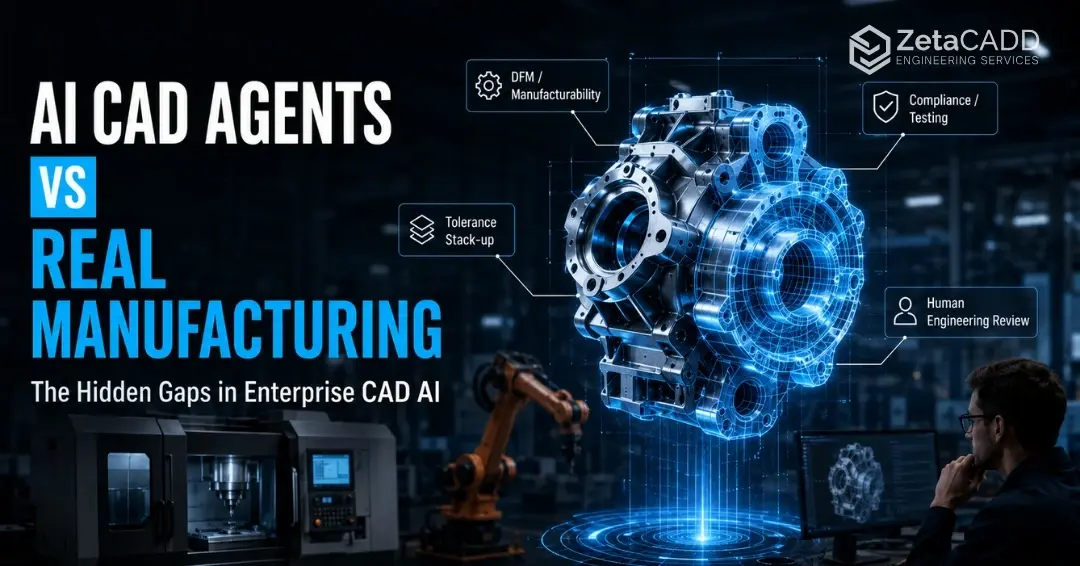
What AI Agents for CAD Engineers Actually Need to Work in Real Manufacturing
The mechanical engineering landscape is experiencing an agentic revolution. With milestones like Leo AI generating full parametric CAD assemblies from text and Neural Concept launching physics-aware design copilots, marketing promises of 10x productivity have reached a fever pitch. Yet, on the shop floor, a stark reality is setting in. There is a vast chasm between generating visually convincing 3D geometry and engineering a buildable, safe physical product.
This article deconstructs twelve critical gaps, ranging from shop-floor constraints and legacy PLM silos to legal liability and silent AI hallucinations, currently blocking enterprise adoption. For engineering leaders and CTOs, navigating this transition requires moving past the hype. AI agents must be viewed as decision-support partners rather than autonomous replacements, requiring strict human oversight to survive the unforgiving constraints of physical manufacturing.
The Promise vs. Reality Gap in Mechanical CAD
Mechanical design is uniquely unforgiving. In software development, an AI-introduced bug is easily rolled back in a repository. In physical manufacturing, an overlooked tolerance stack-up or manufacturing constraint can scrap $50,000 in physical tooling and trigger month-long production delays.
Platforms like Yochana’s “Adam” and specialized layers like bananaz prove that AI can automate tedious CAD tasks, analyze geometry, and learn step-by-step workflows from sketches. However, many leaders are investing blindly, conflating automated drafting with true engineering judgment. Building a resilient, AI-accelerated pipeline requires evaluating how these models perform when confronted with physical, multi-domain, and regulatory realities.
The 12 Critical Gaps to Enterprise AI CAD Adoption
1. Manufacturing Reality and Shop-Floor Constraints
AI models trained purely on digital geometry lack the context of specific fabrication methods. An AI agent might generate an automotive bracket or body-in-white (BIW) structure that is un-machinable due to tool accessibility constraints. Similarly, it may design a cast part missing the necessary draft angles and wall thicknesses required for forging. Without deep integration with Design for Manufacturing (DFM) rules, AI-generated components fail tooling reviews and lead to costly reworks.
2. Engineering Judgment and Legal Accountability
An algorithm cannot sign or place a Professional Engineer (PE) stamp on a blueprint. When a safety-critical structural component fails in the automotive, aerospace, or medical device industries, liability rests solely on human shoulders. Because AI cannot be held legally accountable, it cannot replace human judgment. Systems must be engineered as decision-support frameworks that maintain comprehensive, unalterable audit trails of every AI-suggested design change.
3. Complex Assembly and Multi-Domain Interdependencies
While modern agents can synthesize isolated components, managing massive, multi-domain assemblies remains an unsolved challenge. For instance, an aerospace propulsion system containing over 10,000 interdependent parts requires complex systems engineering. AI struggles to balance the complex interplay of thermal expansion, structural load paths, fluid dynamics, and multi-material joining methods, such as specialized welding, mechanical fastening, or bonding.
4. PLM and PDM Integration into Enterprise Workflows
CAD models do not exist in isolation; they are governed by Product Lifecycle Management (PLM) and Product Data Management (PDM) systems like PTC Windchill, Siemens Teamcenter, or Dassault ENOVIA. Current AI solutions often operate as isolated sandboxes. For true enterprise utility, AI agents must seamlessly integrate with PLM databases to automatically manage Engineering Change Orders (ECOs), populate metadata, and structure complex Bills of Materials (BOM).
5. Real-World Validation and Physical Testing
Digital validation is only an approximation of reality. AI agents typically lack a closed feedback loop with physical test labs using equipment like MTS or Instron strain gauges, environmental chambers, and load cells. True maturity will only be achieved when AI models move beyond idealized digital simulations and ingest real-world failure data from physical prototypes, learning directly from physical breakages and fatigue tests.
6. ROI Evidence and Business Case Clarity
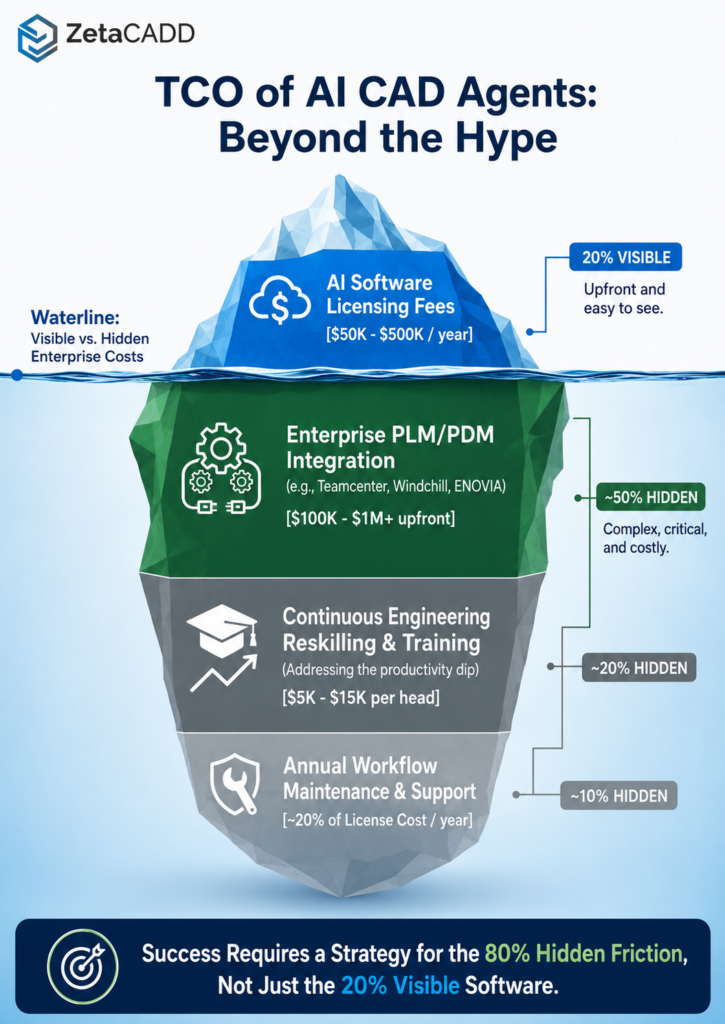
While vendor marketing promises immediate efficiency gains, the true Total Cost of Ownership (TCO) presents a complex financial picture. Enterprise deployments require factoring in steep software licensing, substantial PLM integration fees, and continuous engineering reskilling costs. Given these hidden implementation frictions, most organizations face a realistic break-even timeline of 18 to 36 months rather than immediate savings.
| Cost Category | Typical Enterprise Range | Impact on Implementation Timeline |
| AI Software Licensing | $50,000 to $500,000 / year | Continuous operational expense |
| PLM/PDM Integration | $100,000 to $1,000,000 | Front-loaded implementation friction |
| Engineer Reskilling | $5,000 to $15,000 / engineer | Temporary dip in initial productivity |
7. Workforce Transition and Skills Development
With AI poised to automate over 40% of routine CAD modeling tasks, the traditional engineering career path is fracturing. Historically, junior engineers developed critical spatial intuition and structural understanding through years of basic CAD drafting and part detailing. If AI automates these entry-level tasks, organizations risk creating a generational skills gap where future AI supervisors lack the foundational domain expertise required to spot subtle algorithmic errors.
8. Security, IP Protection, and Compliance
CAD files represent an enterprise’s core intellectual property. Utilizing cloud-based AI agents introduces severe security risks and potential violations of export control regulations, such as ITAR and EAR in defence and aerospace engineering. Widespread adoption requires vendors to provide ironclad on-premise or private-cloud deployments, absolute zero-data-retention compliance, corporate supplier data walls, and clear legal IP indemnification clauses.
9. Legacy System and File Format Compatibility
Most industrial enterprises operate on a historical burden of decades-old legacy CAD data, often trapped in outdated or proprietary versions of CATIA, SolidWorks, or AutoCAD. When migrating or modifying these designs, AI tools frequently struggle to interpret neutral file formats (like STEP or IGES) without losing critical metadata. Furthermore, they remain largely incapable of reverse-engineering the original design intent from unparameterized, “dumb” geometry.
10. AI Hallucination and Error Detection
Unlike textual errors, CAD hallucinations are silent and physically dangerous. An AI agent might introduce a minor, imperceptible modification, such as reducing a bolt hole from 10.5 mm to 10 mm, omitting a structural fillet, or subtly swapping a material grade from Aluminum 7075 to 6061. Without automated geometric rule-checking and rigorous human review workflows, these microscopic anomalies can pass digital validation and cause catastrophic field failures.
11. Physics and Simulation Accuracy
The emergence of physics-aware copilots has revolutionized conceptual screening, enabling engineers to evaluate thousands of design variations in minutes. However, a spark speed-versus-accuracy tradeoff remains. These rapid AI approximations cannot replace high-fidelity, physics-based Finite Element Analysis (FEA) or Computational Fluid Dynamics (CFD) for safety-critical components. A hybrid approach, utilizing AI for concept screening and traditional simulation for final validation, remains mandatory.
12. Industry Standards Compliance and Certification
Engineering designs must comply with rigorous international and industry-specific regulatory standards, such as ASME Boiler and Pressure Vessel Codes (BPVC), ISO/ANSI geometric product specifications, and FDA 21 CFR Part 820 for medical devices. Regulatory bodies certify physical systems and licensed engineers, not neural networks. AI platforms currently lack native compliance frameworks capable of generating the verifiable traceability and audit trails required for formal certification dossiers.
Strategic Recommendations for Engineering Leaders
To capture the true value of generative engineering without exposing the enterprise to operational risks, technology leaders should implement a structured, four-phase adoption framework:
- Phase 1: Assessment (Months 1 to 2): Audit workflows to identify high-volume, highly repetitive bottlenecks (such as fastener matching, drawing detailing, or automated BOM generation) best suited for initial automation.
- Phase 2: Pilot (Months 3 to 6): Deploy specialized agentic tools on bounded, low-risk, non-safety-critical components to establish baseline productivity and cycle-time metrics.
- Phase 3: Integration (Months 6 to 12): Securely bridge AI tools with existing PLM/PDM environments and embed custom, proprietary corporate DFM rules into the AI loop.
- Phase 4: Scale (Months 12 to 18): Roll out copilots enterprise-wide, shifting senior engineering roles from manual modelers to strategic AI design reviewers and system architects.
When vetting vendors, leaders must cut through generic marketing by asking precise operational questions regarding ITAR compliance, geometric tolerance stack-ups, and parametric feature tree preservation during export. Red flags include vendors claiming their software will completely replace human mechanical engineers, a lack of clear liability frameworks, or an absence of enterprise case studies with post-implementation, real-world metrics.
Bridging the Gap with Expert Support
AI agents are fundamentally transforming the CAD landscape, but they are not a magic bullet. The future of mechanical engineering does not belong to fully autonomous algorithms, but rather to a hybrid architecture that pairs computational efficiency with human accountability. By actively addressing these twelve structural gaps, manufacturing leaders can successfully cross the chasm from digital hype to physical reality.
While automated tools and AI copilots continue to evolve, successfully scaling your engineering capacity requires proven, production-ready expertise.
If you want to ensure your designs seamlessly bridge the gap between digital concepts and flawless manufacturing execution, connect with ZetaCADD for professional, reliable 3D CAD Modeling Services tailored to your strict enterprise standards.